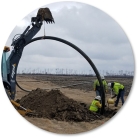
At the factory in Drayton, North Dakota, GHG emissions analysis supported the decision to change the fuel source for a new lime kiln from coke to natural gas, which was the lowest-carbon path forward. The company invested in a new natural gas-fired kiln, increasing production capacity by nearly 30 percent while improving energy efficiency and reducing emissions intensity. This project was paired with a strategic partnership with Dakota Natural Gas to extend pipeline infrastructure to the factory and the surrounding community. Commissioned in early 2021, the project not only supported operational resilience but also enabled broader regional access to a lower-emission energy source.
A similar approach was implemented at the factory in Hillsboro, North Dakota, where rising beet pulp volumes exceeded drying capacity. By anchoring the development of a 27-mile natural gas pipeline in collaboration with Traill County stakeholders, American Crystal unlocked a long-constrained energy solution for the region. The transition to natural gas improved dryer efficiency, met increased heat demand, and optimized coproduct utilization. As a result, the factory increased production of beet pulp pellets, reduced land application of excess pulp, and decreased transportation-related emissions from hauling.
These investments delivered measurable environmental and social outcomes. Energy efficiency improvements and fuel switching reduced operational emissions intensity, while infrastructure expansion provided more than 1,000 local businesses and households with access to a more cost-effective and lower-emission energy source. Collectively, these initiatives demonstrate American Crystal’s ability to scale production responsibly, strengthen rural energy systems, and create shared value for growers, employees, and communities.