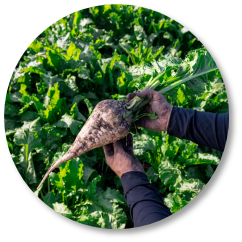
Adverse weather, disease, insects, and weeds can be devastating to sugarbeet production, and growers are challenged to increase productivity with every crop despite these challenges. Growers have made significant investments in research advancements in agronomic practices and technologies to increase yields. Through improvements in planting efficiency, fertilization, seed varieties, and precision farming practices, harvests today yield 58 percent more recoverable sugar per acre on 20 percent fewer acres than harvests 20 years ago.
American Crystal agronomists, in partnership with researchers at North Dakota State University and the University of Minnesota, work closely with growers to refine best practices, improve efficiency, and reduce environmental impact by utilizing starter fertilizer, zone soil sampling, and cover crops. Nutrient uptake is improved by applying starter fertilizers directly in the furrow next to the seed at planting, and 76 percent of the cooperative’s sugarbeet acres follow this practice. Zone soil sampling and precision application technology prevent nitrogen overapplication, ensuring it is applied where needed. Nearly half of the cooperative’s planted acres use this more efficient practice. Adding cover crop protection gives seedlings shelter from wind and soil erosion. Spring or fall-seeded cover crops, such as barley, wheat, or rye, provide seedlings shelter from wind and soil erosion, a practice benefiting over 45 percent of grower acres.
Science-based soil management and precision planting practices are advancing both agronomic performance and responsible resource use. These continuous improvements support higher recoverable sugar per acre while investing in long-term resilience for farmers, employees, and communities.